Overview
The core server is built around one rule: MujocoEnv is the only simulation owner. Everything else that used to be entangled with it — runtime option mutation, plugin lifecycle, offscreen rendering — is now a focused module behind a synchronized entry point. None of those modules is allowed to become a second owner of the model, the data, or the simulation lifecycle.
Ownership map
MujocoEnvOwns
mjModelandmjData, the simulation lifecycle, physics stepping, model loading and replacement, and the coordination that keeps the other modules in step with all of that.Runtime Options(runtime_options.hpp)Owns the typed
RuntimeOptionsSnapshot/RuntimeOptionsPatchcontract, field validation, and the mapping to and frommjOption. It does not ownmjModel,mjData, or a persistent copy of the active options — every read goes back to the live model.Plugin Host(plugin_host.hpp)Owns the set of loaded plugin adapters, callback dispatch, reset and geometry notifications, statistics, and reload ordering for that set. It does not own
mjModel,mjData, or physics stepping.RenderCore(rendering/render_core.hpp)Owns camera descriptors, render-backend lifecycle and thread affinity, copied render snapshots, frame storage and leases, and publication-demand scheduling. It does not own
MujocoEnv, ROS nodes, ROS message types, or transport timestamps.- Transport adapters (ROS 1, ROS 2, Python)
Own parameter/message parsing, pluginlib construction, ROS node setup, and transport-specific timestamps. They translate at the boundary; they do not parse, validate, or mutate core state directly.
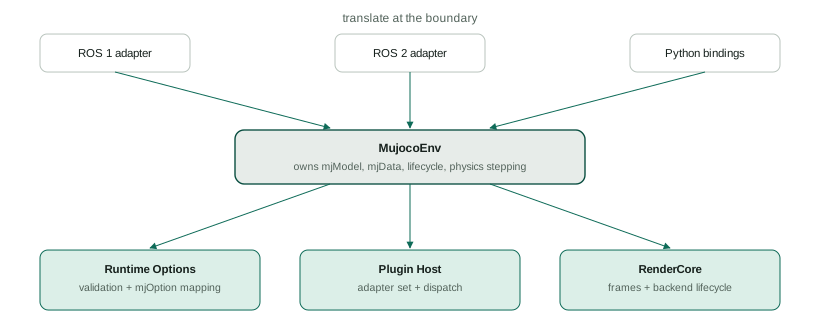
Every transport translates into MujocoEnv, which is the only thing that owns the model and orchestrates the three focused modules below it.
See RenderCore, Plugin Host, and Runtime Options for how each of these actually works.
Generations
Four independent counters make “which epoch does this belong to” an explicit, checkable value instead of an assumption:
ModelGeneration    one mjModel/mjData ownership epoch
PluginGeneration   the adapter set loaded against one ModelGeneration
FrameGeneration    one render layout/camera configuration
OptionsEpoch        one successfully applied Runtime Options update
Each is a distinct type (GenerationId<Tag> in generation.hpp), so a FrameGeneration and a PluginGeneration cannot be compared or assigned to each other by mistake even though both are, underneath, just an integer. A render turn, a plugin dispatch, and a runtime-option update each carry the generation they were issued against, and every one of those seams rejects a call whose generation no longer matches current state rather than silently acting on stale data.
Lock order
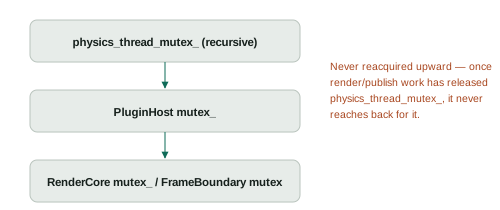
Fixed acquire order. Code that has released a lower lock never reaches back up the chain for one it already left.
In particular, once render or publication work has released physics_thread_mutex_ (see RenderCore), it never reacquires it while waiting on the render thread, a backend call, or a subscriber.
Reload touches all three modules, in this order
A model reload is the one operation that has to coordinate PluginHost and RenderCore together under MujocoEnv. At a glance:
1. physics_thread_mutex_ acquired
2. PluginHost::QuiesceAndDestroy()      -- old adapters gone
3. RenderCore stops admission, cancels the current/queued render turn
4. physics_thread_mutex_ released while RenderCore settles and any
   already-admitted render turn drains its unlocked publish tail
5. old cameras detached from the retiring RenderCore
6. physics_thread_mutex_ re-acquired; model/data swap; ModelGeneration++
7. mj_forward() -- no plugin adapters exist yet, so no callbacks fire
8. pending startup Runtime Options apply as one transaction (if any)
9. new PluginGeneration loads and activates
10. outside the physics lock: RenderCore reconfigures for the new
    model -- new FrameGeneration, cameras rebound, Python consumers
    rebound
The callback-free window is not incidental: it stops an old plugin instance from ever observing the new model/data pair. Plugin Host covers why that window exists and how it is enforced. RenderCore covers the corresponding render-core lifecycle in the same detail.
Env teardown (destroy, not reload) drains consumers and joins RenderCore before PluginHost and the rest of MujocoEnv tear down — see RenderCore (“How env teardown joins RenderCore”). That path is separate from reload and must not leave a live render thread across executor/TF destruction.
Failure philosophy
Every seam returns an explicit status rather than throwing away information: RenderStatus/FrameStatus for rendering, RuntimeOptionsError for options, PluginLoadFailure for plugins. A rejected Runtime Options patch changes nothing. A plugin that fails to load stays visible in statistics but never receives a callback. A full frame store drops the new frame and reports it rather than blocking the render thread or silently overwriting a lease a consumer still holds. Nothing is fabricated to paper over a failure that could instead be reported.