Robot Description
URDF bundle loading
mujoco_ros can load a robot from a URDF description bundle instead of a
standalone MJCF model. The smallest installed example is a two-link robot with
primitive visual geometry only:
roslaunch mujoco_ros simple_visual_robot.launch
ros2 launch mujoco_ros simple_visual_robot.launch.py
ros2 launch mujoco_ros simple_visual_robot.launch.xml
The example URDF lives at
mujoco_ros/examples/robot_description/simple_visual_robot.urdf. Its root
link is named chassis rather than base_link so the converter exercises
the inferred-root path instead of relying on a conventional link name.
This example intentionally uses only URDF primitive visual geometries
(box and cylinder). When a link has primitive visuals but no collision
geometry, the converter mirrors those primitives into collision geometry before
handing the URDF to MuJoCo so the resulting robot has real geoms in the
Simulation Model.
Mesh filename URIs are normalized before MuJoCo parse. MuJoCo 3.3.5 also
does not load .glb, and only loads binary STL (and OBJ), not ASCII
STL – both are handled as an explicit pipeline before the mesh reaches
MuJoCo:
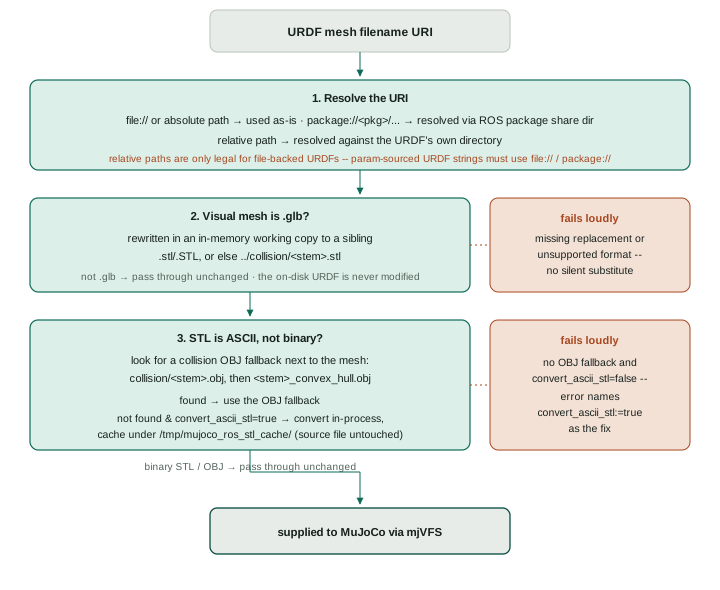
Every stage either passes the mesh through unchanged or fails loudly – nothing is silently substituted, and the on-disk URDF and source mesh are never modified.
file://and absolute paths are used as-is.package://<pkg>/...resolves via the ROS package share directory.Relative paths (e.g.
meshes/collision/foo.obj) are resolved against the URDF file’s directory and are only legal for file-backed URDFs. Param-sourced URDF strings must use absolute,file://, orpackage://mesh URIs.
Meshes are supplied to MuJoCo through mjVFS with basename keys while
strippath remains enabled.
Geom groups
After parsing, robot geoms are assigned MuJoCo geom groups so collision
hulls don’t dominate the viewer over visual meshes: geoms with
contype == 0 && conaffinity == 0 (visual) are put in group 1 with
contype/conaffinity forced to 0, and all other geoms (collision)
are put in group 2 when the robot has visuals. When the robot has no
visual geoms, collision geoms use group 1 so they remain visible under
default viewer flags.
The interactive viewer calls ApplyInteractiveViewerGeomDefaults after
mjv_defaultOption and turns geom group 2 off by default, hiding
description collision hulls while keeping visual meshes visible. Users can
re-enable group 2 in the viewer UI.
Extended Params
Extended Params is a generic, public SRDF extension carrying per-joint
physical characterization. See docs/GLOSSARY.md’s “Extended Params”
glossary entry for the one-paragraph definition; this page describes the
canonical mujoco_ros::ParseSrdfExtensions path
(mujoco_ros/include/mujoco_ros/extended_params.hpp,
mujoco_ros/src/extended_params.cpp).
Document shape
<robot name="<robot name>">
  <extended_params name="<joint name, matching the URDF joint name exactly>">
    <mujoco_actuator kp="..." kv="..." armature="..."/>
    <mujoco_gravcomp value="..."/>
    <vendor_tag vendor_attribute="..."/>
  </extended_params>
  <!-- repeat <extended_params> per joint -->
</robot>
SRDF supplied through srdf.path (or the equivalent SRDF argument) is
the only supported input for Extended Params. A standalone
<extended_params> XML document is not accepted – put <extended_params>
entries directly in the robot’s SRDF.
Core parses only two built-in child elements:
mujoco_actuator: optional, independently validatedkp,kv, andarmatureoverrides for generated actuators. Each value must be finite and non-negative.mujoco_gravcomp: requiredvalueattribute. The value must be finite and is applied to the joint’s parent body.
All other child elements are custom tags. Core preserves their XML and sends
each tag to a handler registered with
mujoco_ros::RegisterExtendedParamsHandler. A handler receives the joint
name, tag name, XML element, and a pass-through
ConverterExtensionContext. Core does not validate custom-tag attributes or
interpret their values. If no handler is registered, core warns and skips the
tag. This allows downstream packages to own schemas such as
friction_parameters, motor, and compliance.
Fields
Built-in mujoco_actuator values are stored in
mujoco_ros::ExtendedParamsByJoint. Custom-tag fields are not part of the
core schema. The package that registers the handler defines, validates, and
consumes them.
What Extended Params does not do
Built-in mujoco_actuator values are used during optional actuator generation.
Custom-tag values are passed to registered handlers through
ConverterExtensionContext. Core does not derive damping, friction, motor,
compliance, or other physical values from custom tags.
URDF joint friction
A <joint> element may carry the ROS <friction> extension (ds,
vd, k1, k2, k3). MuJoCo’s URDF importer ignores that tag, so
the converter parses it itself (mujoco_ros::ParseUrdfJointFriction) and
applies it to the joint’s child link geoms
(mujoco_ros::ApplyUrdfJointFriction):
ds(dry friction coefficient) scales MuJoCo’s conventional slide/spin/roll ratio:fric = [ds, ds*0.005, ds*0.0001].vd/k1/k2/k3are decay-rate/stiffness terms of the ROS bristle contact model. MuJoCo’s friction cone has no analog for them, so they are ignored.A
<friction>tag without a usabledsis warned and skipped; the geoms keep MuJoCo’s default1 0.005 0.0001.
This is distinct from the friction_parameters Extended Params tag (joint
dynamics), which core never parses. The runtime SetGeomProperties service
still overrides these values, since it writes after load.
Actuator generation
When a URDF handed to the converter contains a <ros2_control> block (standard ROS 2 syntax –
<joint name="..."><command_interface name="position|velocity|effort"/></joint>), the converter
can generate one native MuJoCo <actuator> per (joint, command_interface) pair, before
mj_compile(). This is opt-in: set description.generate_actuators:=true (default false)
on the description-bundle params, or pass generate_actuators=true directly to
ConvertDescription/SaveDescriptionToTempMjb/load_model_from_description.
Why opt-in: mujoco_ros_control already dispatches control commands through its own
ros2_control-driven Actuator-Routing/Generalized-Force-Fallback split and does not need native
actuators to function. Auto-generating them unconditionally would silently change the physical
behavior of every existing mujoco_ros_control deployment (its qfrc-fallback path defers
entirely to whichever actuator gains exist, once one exists for a joint). Only callers that
structurally need native actuators should set this true.
Naming: <joint_name>_act_pos / _act_vel / _act_eff – this matches
mujoco_ros_control’s existing, already-shipped actuator lookup convention exactly, so it picks
up generated actuators automatically with no changes on its side.
Ranges: ctrlrange/forcerange always come from the URDF’s own <joint><limit .../> –
never invented. A joint requesting any command_interface with a missing <limit>, or a
<limit> missing the attribute that interface needs (effort always; additionally
lower/upper for position, velocity for velocity), is a hard error.
Gains: fixed, conservative, un-tuned-for-any-robot defaults (documented in
description_converter.cpp). Override per joint via a new optional Extended Params child
element:
<robot name="<robot name>">
  <extended_params name="<joint name>">
    <mujoco_actuator kp="..." kv="..." armature="..."/> <!-- each attribute independently optional -->
  </extended_params>
</robot>
forcerange/ctrlrange are deliberately not overridable through this element – they
always track the URDF’s own <limit>.
Mimic joints: a joint that is a URDF <mimic> follower and is also claimed by
<ros2_control> is a hard error (it would fight the driver joint’s actuator). Full
<mimic> → MJCF <equality> porting is separate, tracked roadmap work; this converter does
not generate equality constraints today.
Attach prefix: the compose-time body/joint/actuator name prefix (ComposeOptions::prefix,
description.attach_prefix) defaults to an empty string, not a hardcoded value – a
single-robot bundle produces unprefixed names by default. Multi-robot callers needing distinct
namespacing pass an explicit prefix (e.g. "r0_"/"r1_").