RenderCore
RenderCore is the transport-neutral rendering seam: it turns a physics-step snapshot into leased, immutable frame planes that any number of consumers — ROS 1, ROS 2, Python — can read without triggering a second render or blocking on each other. This page describes the mechanism in enough detail to extend it without breaking the ownership boundary: what RenderCore owns, what runs on which thread, and exactly how a reload and a render turn stay out of each other’s way.
Ownership
RenderCore owns:
Camera descriptors and the render plan they produce (
rendering/camera_descriptor.hpp,rendering/render_demand.hpp).The render backend and its thread affinity (
rendering/render_backend_interface.hpp).Copied render snapshots (
rendering/render_snapshot.hpp).Frame storage, leases, and generations (
rendering/frame_boundary.hpp).
RenderCore does not own MujocoEnv, ROS nodes or message types, or transport timestamps. Those stay with MujocoEnv and the transport adapters (OffscreenCamera for ROS, CameraPublicationTransport for Python) described at the end of this page.
Capacity is a budget decided up front
A RenderCore is constructed with a fixed max_slots/max_bytes ceiling that never grows for the lifetime of that instance. Before any camera set is accepted, ReconfigureRenderCore (on MujocoEnv) computes exactly how many slots and bytes the configured cameras and any registered Python history depth actually need — ComputeFrameSlotCapacity, ComputeFrameByteCapacity, ComputeWarmSlotCount in rendering/frame_capacity.hpp — using overflow-checked arithmetic, and throws before touching RenderCore at all if that requirement exceeds the fixed budget. Capacity failure is therefore a configuration-time error, not something discovered mid-render.
The frame store: FrameBoundary, FrameWriter, FrameLease
FrameBoundary preallocates max_slots storage objects once, at construction, and never allocates a new one afterward. Writing and reading against that fixed pool works like this:
TryAcquireWriter(generation, plane, layout)reserves one slot’s worth of capacity and hands back aFrameWriterwith a scratch byte buffer to fill. The reservation is accounted separately from committed storage (reserved_slots/reserved_bytesvs.committed_bytes) so two writers can be in flight without either overcommitting the budget.FrameWriter::Commit()is the only thing that makes a frame visible: it swaps the scratch bytes into a pooledStorageslot, stamps it with aFrameStamp(capture id, camera id, a per-plane monotonically increasingplane_sequence, the model and frame generation, and the simulation timestamp), and appends it torecords.A
FrameWriterthat is destroyed without being committed releases its reservation automatically. An exception thrown while filling the buffer — or a stale-generation/capacity rejection returned byTryAcquireWriteritself — can never leak a permanently reserved slot.A
FrameLeaseis ashared_ptr<const Storage>. Any number of leases can point at the same committed frame; the frame’s storage is kept alive by that reference count, independent of whateverFrameBoundaryitself is doing.
When Commit() needs a free pooled slot and none is marked free, it calls EvictOldestUnleasedRecord, which scans records oldest-first and reclaims the first one whose use_count() == 1 — meaning nothing outside FrameBoundary still holds a lease on it. A record that a consumer is still leasing is structurally unreachable to the evictor; if every record is currently leased and no pooled slot is free, the commit fails explicitly with kFrameSlotsExhausted rather than growing the pool or blocking the render thread.
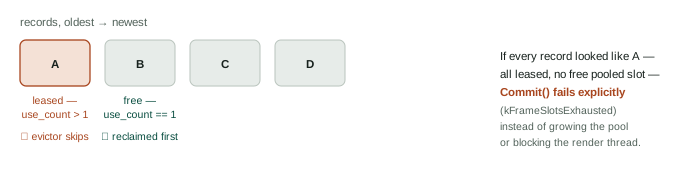
Eviction only ever reclaims an unleased record, oldest-first. A frame a consumer still holds is structurally unreachable to the evictor.
Render backpressure is explicit
RenderBackpressurePolicy defaults to kDrop (drop). If a capture
cannot obtain a bounded slot, the render turn reports kFrameSlotsExhausted
and the render thread remains non-blocking. The opt-in kWaitForSlot
(wait_for_slot) policy moves the wait to the physics-side submission path,
after physics_thread_mutex_ is released. A lease release wakes the wait.
Cancellation, reload, shutdown, and a policy change back to drop wake it
with an explicit stopped status. The pool never grows and existing leases are
never invalidated.
Generation staleness is checked twice
A render turn’s generation is checked once when it is queued (RenderCore::SubmitSnapshot compares the snapshot’s ModelGeneration and the plan’s FrameGeneration against current state) and again when the render thread actually picks it up (RenderLoop recomputes stale_turn against the live configuration_). The second check exists because Reconfigure() can run and supersede an already-queued turn before the render thread gets to it. A stale turn is dropped without ever touching the graphics backend.
SnapshotPool: decoupling the physics thread from the render thread
RenderSnapshot carries a shared_ptr<mjData> that is a copy, never the live simulation’s own mjData. That copy comes from SnapshotPool, which holds exactly two mjData slots per active ModelGeneration:
Activate(model, generation)allocates both slots (mj_makeData) when a model finishes loading;Deactivate()frees them.Acquire(model, source, generation)runs on the physics thread, right aftermj_step. It rejects immediately if the requested generation isn’t the active one, and otherwise ``mj_copyData``s into whichever of the two slots is currently free.The returned
shared_ptr<mjData>carries a deleter that flips its slot back to free — a caller never has to remember to release it explicitly.If both slots are already leased — for example, a slow previous render turn is still holding one —
AcquirereturnskExhaustedimmediately. The physics step drops that capture rather than blocking or growing the pool.
This is the only place where simulation state crosses from the physics thread into rendering: everything downstream of Acquire (plugin geometry included — see below) works off an owned copy, never a live pointer.
DemandScheduler: deciding whether to render at all
Each registered consumer is one of three modes:
Cadenced — due once its registered interval has elapsed since its last delivery.
One-shot — due only after an explicit
RequestOneShot, and not due again until requested again.Continuous — always due while enabled.
Evaluate(simulation_time, camera) walks consumers in a fixed, id-sorted order and returns a RenderPlan whose consumers list is exactly the ones due right now for that camera. An empty list is a valid outcome: RenderCore::SubmitSnapshot treats a plan with no consumers as a no-op success, so a camera nobody is watching costs nothing beyond the demand check itself — no render, no snapshot copy for that camera. MarkDelivered is the only thing that advances a cadenced consumer’s clock or clears a one-shot flag; a consumer that is never marked delivered stays due indefinitely.
The render backend and thread affinity
IRenderBackend has exactly one thread it is ever called from: the std::thread that RenderCore starts for itself and joins in Shutdown(). Initialize, Resize, Render, and ShutdownOnRenderThread all run there — no other code path creates or tears down a graphics context. Shutdown() calls IRenderBackend::RequestStop() before joining so a backend blocked inside Render() can unblock; the default is a no-op, and test backends override it when they park on a barrier. The compiled backend is GLFW (a hidden window with its own context; on Linux/X11 that window is created and destroyed only on the RenderCore thread and is never shared with the visible viewer), EGL, or OSMesa, selected at build time. A disabled backend exists when offscreen rendering is turned off at configure time and reports every call as kBackendUnavailable.
A render pass:
Updates the scene from the snapshot’s model/data and the camera’s visual options (
mjv_updateScene).Appends the plugin-contributed geometry — a plain
vector<mjvGeom>already copied by the physics thread (see below) — directly into the scene’s geometry buffer, failing loudly if it doesn’t fit rather than silently truncating it.Reads whichever planes were requested: RGB and segmentation share one color-read path with a scene flag toggle; depth is read as raw buffer values and converted to metric distance using that model’s
vis.map.znear/zfarandstat.extent— a per-model calibration, not a fixed constant.Commits each plane through a
FrameWriteras described above.
Plugins never receive a callback from the render thread. MujocoEnv collects plugin render geometry once, on the physics thread, into a scratch scene and copies the resulting geoms into a plain vector before handing it to RenderCore as part of the snapshot — the render thread only ever sees that already-captured copy.
At most one render turn in flight
A RenderCore holds at most one pending_turn_ at a time. Submitting a second snapshot while one is already queued is rejected with kBusy rather than queued behind it. In steady-state stepping this rarely matters, because the physics step always waits for FinishOrCancelRenderTurn before it can submit again; it matters during recovery and reload paths, where it keeps RenderCore’s state machine simple instead of needing an internal queue.
The physics-step pipeline
This is MujocoEnv::WrappedStep (physics.cpp), the actual per-step sequence:
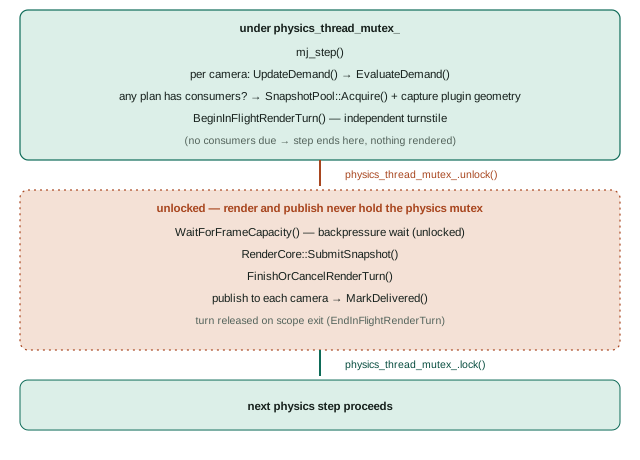
Everything below the dashed line runs with physics_thread_mutex_ released.
BeginInFlightRenderTurn runs while the physics mutex is still held. The mutex is released before WaitForFrameCapacity, submit, finish, and publish, and only re-acquired once that unlocked work is done. Rendering and ROS publication can be slow — backend calls, subscriber-count checks, message construction — and holding physics_thread_mutex_ across all of that would stall every other thread that needs it (control input, the viewer, plugin services) for the duration of one render. BeginInFlightRenderTurn/EndInFlightRenderTurn (an RAII guard backed by render_turn_mutex_ and in_flight_render_turn_count_) is a second, independent gate that exists specifically so reload can still know when it is safe to proceed, without needing the physics mutex held for that entire unlocked window.
How reload actually unwinds RenderCore
Continuing from the reload summary in Overview, the RenderCore-specific part in the order it runs:
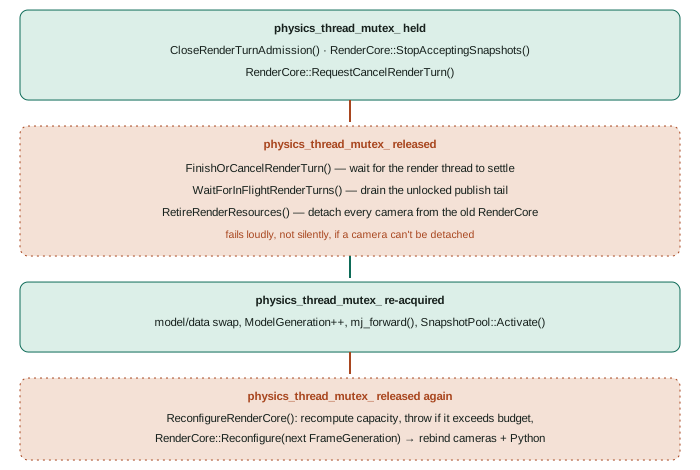
RenderCore::Reconfigure internally waits for its own idle condition – nothing queued or rendering – before it swaps in the new camera set, so this step never races the render thread even though it runs outside the physics lock.
RenderCore::Reconfigure is itself synchronized against the render thread: it waits on RenderCore’s own idle condition until no turn is queued or rendering before it touches cameras_, model_generation_, or configuration_.generation. Nothing about the old camera set or frame layout is visible again after this point — including to Python, which is checked separately below.
How env teardown joins RenderCore
Reload retires one RenderCore and builds another. Env teardown must join the render thread and drop every consumer alias before MujocoEnv member destruction runs, or cameras that still hold shared_ptr aliases can keep the old core alive across executor and TF teardown.
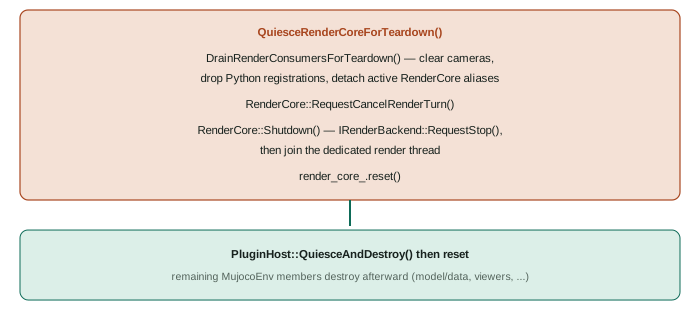
QuiesceRenderCoreForTeardown runs from ~MujocoEnv (and from the ROS 2 test wrapper before executor cancel) so the join happens while plugin_host_ and the cameras are still alive.
Order that matters:
Drain consumers first — unregister Python consumers, clear
OffscreenCameraaliases, unregister the env’s own render consumer.Cancel the in-flight turn, then
Shutdown()(RequestStop+ join). Do not leave a blockedRender()holding the join.Quiesce
PluginHostnext so adapter LifecycleNodes leave the executor while both still exist.Do not eagerly
reset()TF listeners to force ordering. Cancel/join the ROS executor before TF members destroy naturally; prematuretf_*.reset()has regressed DISABLE/ROS 1 cells.
Fan-out to consumers
ROS. Each camera owns a small dedicated worker thread (BoundedPublicationQueue<PublicationItem>, depth 2, latest-wins), so OffscreenCamera::PublishLatest only has to build the item and enqueue it — it never blocks the physics-step caller on a subscriber. A publication_sequence_ counter, whose low bit doubles as a busy flag, lets a queued item detect — right before it actually publishes — whether the demand that produced it has already been superseded by newer demand; if so, the worker drops it instead of publishing something stale.
Python. CameraPublicationTransport remembers, per registration, exactly which RenderCore instance and which camera it was registered against. Every acquisition re-checks three independent things before handing back a lease:
ActiveRenderCore()is still the same instance the registration was made against — catches a full RenderCore replacement.That instance’s current
FrameGenerationstill matches what the registration observed — catches a reconfigure (new camera set / layout) on the same instance.The lease actually returned still carries that same generation — a final check against the value, not just the counter.
Any mismatch raises rather than silently returning a leftover frame from a generation that no longer exists.
Failure taxonomy
RenderStatusCode (backend-facing) and FrameStatusCode (frame-boundary-facing) both distinguish an ordinary, expected miss — no consumer had demand, a plane wasn’t available yet, a slot was momentarily exhausted, a generation was stale — from a context-integrity failure (kBackendFailure, kBackendUnavailable, kTerminalError). IsContextIntegrityFailure is the single predicate that draws that line. Only a context-integrity failure escalates into RenderCore’s terminal_status_, which then rejects every further submission until the backend is torn down and reinitialized. Frame leases already committed before a backend failure remain valid and readable — a broken backend does not retroactively invalidate frames a consumer is already holding.